
Jacketed Reactor Manufacturer in India
Custom-Engineered Jacketed Reactor for Precise Heating, Cooling & Process Control
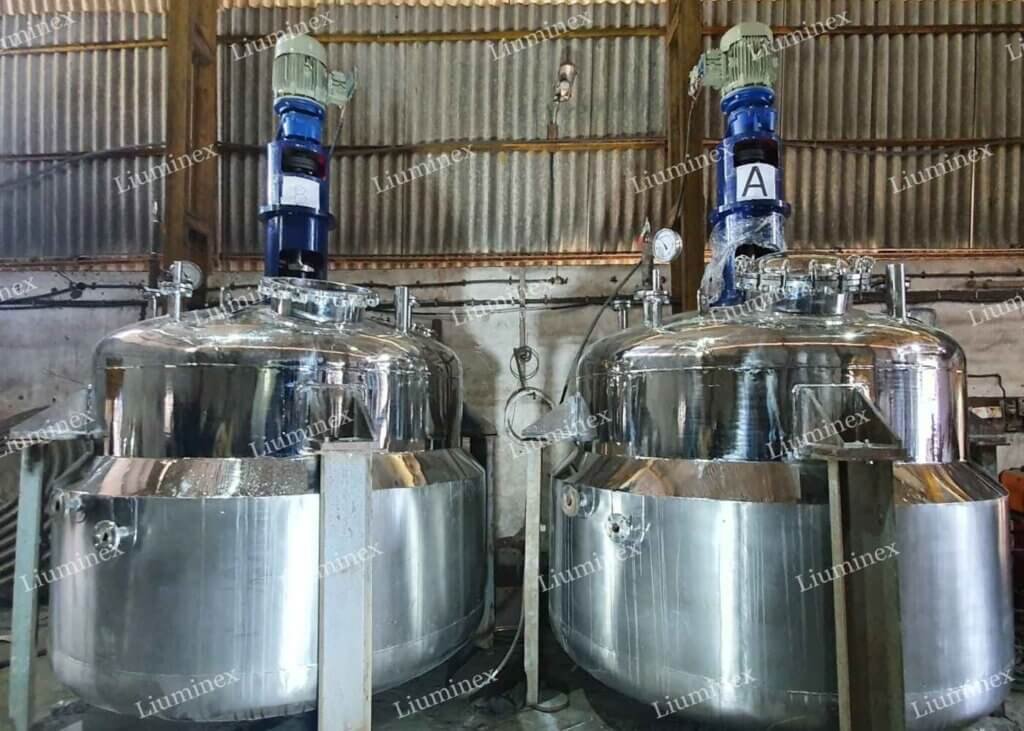
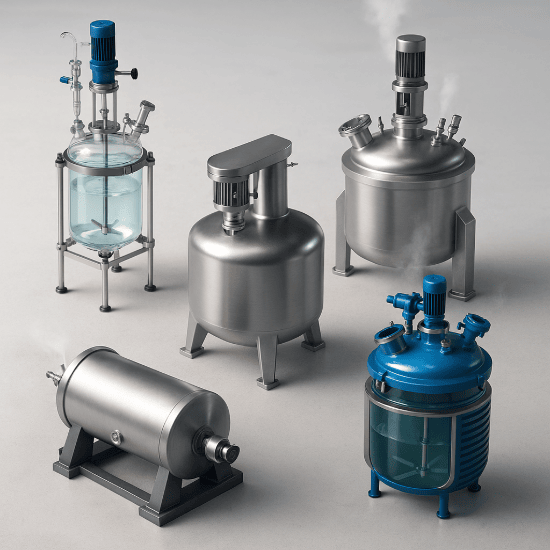
As a jacketed reactor manufacturer, Liuminex manufactures high-performance jacketed reactors and jacketed reaction vessels (Jacketed Reactor Manufacturer) designed for controlled heating, cooling, mixing and chemical processing across a wide range of industries.
Our jacketed reactor are engineered according to individual process requirements, including vessel capacity, material of construction, operating pressure, temperature, jacket configuration, agitator type, heating and cooling media, surface finish and automation requirements.
With capacities ranging from 50 Litres to 50,000 Litres, Liuminex provides customized reactor solutions for chemical manufacturers, pharmaceutical companies, paint and resin manufacturers, lubricant and grease producers, petrochemical companies and specialty chemical industries.
Looking for a custom jacketed reactor Manufacturer? Get in touch with Liuminex for an application-specific solution.
What Is a Jacketed Reactor?
A jacketed reactor is an industrial reaction vessel equipped with an external jacket surrounding the main process vessel.
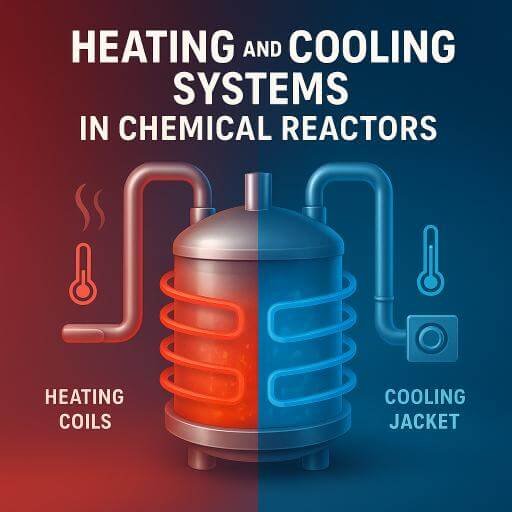
The jacket provides a controlled path for circulating a heating or cooling medium such as steam, thermic fluid, hot water, chilled water or brine. Heat is transferred through the vessel wall without allowing the heating or cooling medium to come into direct contact with the process material.
This indirect heat-transfer arrangement makes jacketed reactors suitable for processes where accurate temperature regulation, uniform heating or cooling and controlled reaction conditions are important.
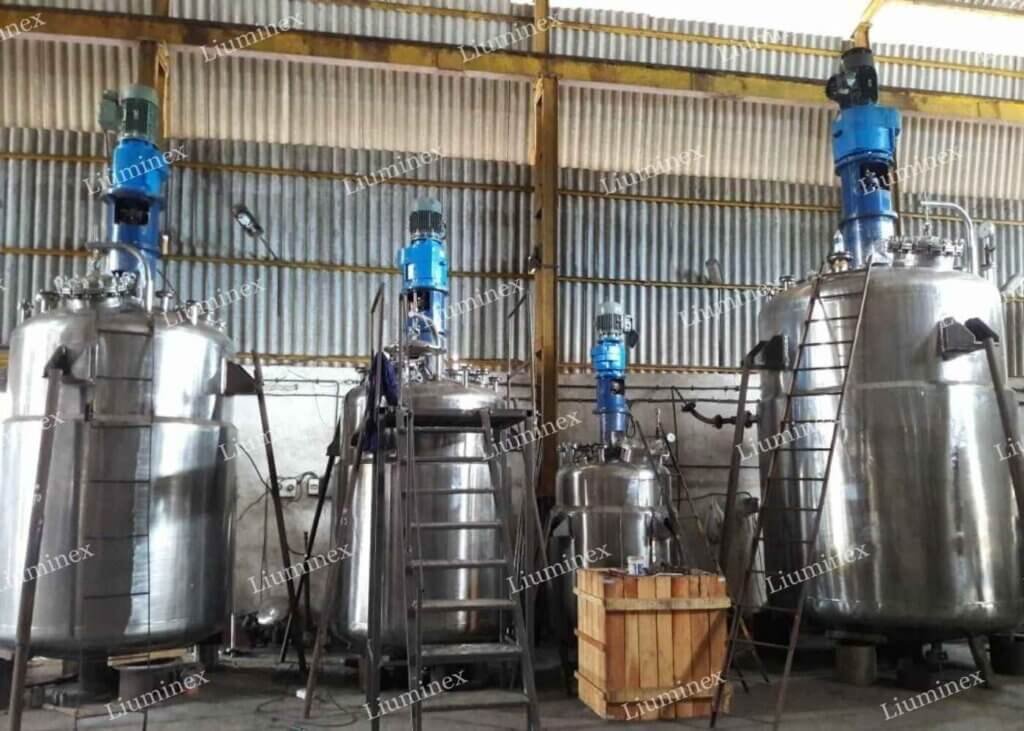
Jacketed reactor are commonly used for chemical reactions, polymerization, condensation, blending, neutralization, resin production, pharmaceutical processing, paints, adhesives, lubricants and other temperature-sensitive processes.
Liuminex designs jacketed reaction vessels in customized capacities and materials to match the specific process requirements of each application.
How Does a Jacketed Reactor Work?
The working principle of a jacketed reactor is based on indirect heat transfer combined with controlled agitation.
The process material is loaded into the main vessel while the required heating or cooling medium is circulated through the external jacket.
1. Process Material Charging
Raw materials, solvents, chemicals or other process ingredients are introduced into the reactor through the appropriate inlet or charging arrangement.
2. Agitation and Mixing
An agitator mixes the contents of the vessel to maintain uniformity and improve heat transfer.
The agitator configuration can be selected according to viscosity, mixing requirements, solids content and the nature of the process.
3. Heating or Cooling
The required heat-transfer medium circulates through the reactor jacket.
Heating may be achieved using:
- Steam
- Thermic fluid
- Hot water
Cooling may be achieved using:
- Chilled water
- Brine
- Other suitable cooling media
4. Controlled Temperature
Heat passes through the reactor wall into or out of the process material.
Temperature measurement and control systems can be incorporated according to the process requirements.
5. Reaction and Processing
The material is maintained at the required temperature and mixing conditions until the desired reaction or processing stage is completed.
6. Product Discharge
The finished material is discharged through the designated outlet or bottom discharge arrangement, depending on the reactor design.
Key Features of Liuminex Jacketed Reactors
Liuminex jacketed reactors can be customized around the actual process and plant requirements.
Capacity Range
50 Litres to 50,000 Litres
Material of Construction
Depending on chemical compatibility and process requirements:
- SS 304
- SS 316
- Mild Steel
- Hastelloy
- Alloy 20
Jacket Configurations
- Dimple Jacket
- Conventional Jacket
- Half-Pipe Coil
Heating Media
- Steam
- Thermic Fluid
- Hot Water
Cooling Media
- Chilled Water
- Brine
Agitator Options
- Anchor
- Paddle
- Turbine
- Helical
- Magnetic
Surface Finish
- Mirror Finish
- Matt Finish
- Electro-Polished
Mounting Options
- Skid Mounted
- Leg Supported
- Platform Based
Process Connections
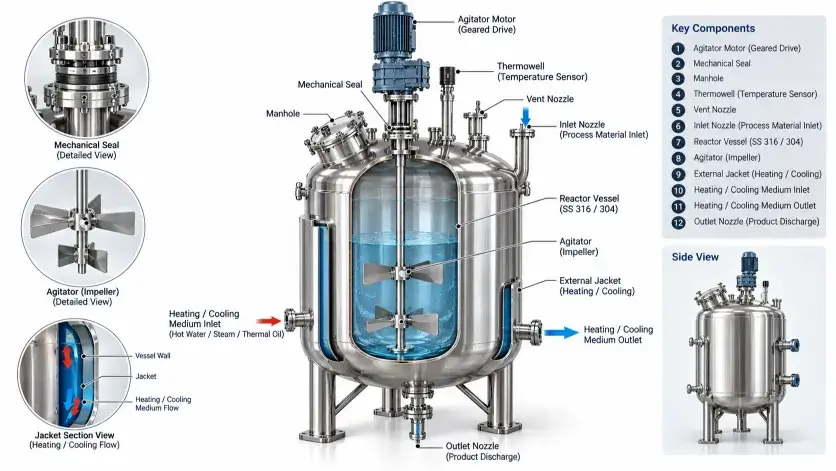
Typical connections can include:
- Inlet
- Outlet
- Manhole
- Thermowell
- Vent
- Other application-specific nozzles
These specifications are configurable according to the customer’s process and equipment requirements.
| Parameter | Specification |
|---|---|
| Capacity | 50 L to 50,000 L |
| Material of Construction | SS 304, SS 316, MS, Hastelloy, Alloy 20 |
| Jacket Type | Dimple / Conventional / Half-Pipe Coil |
| Heating Media | Steam / Thermic Fluid / Hot Water |
| Cooling Media | Chilled Water / Brine |
| Design Pressure | Up to 25 bar |
| Jacket Pressure Rating | 3–10 bar, customizable |
| Temperature Range | -20°C to 300°C |
| Agitator | Anchor / Paddle / Turbine / Helical / Magnetic |
| Surface Finish | Mirror / Matt / Electro-Polished |
| Mounting | Skid / Leg Supported / Platform Based |
Final design parameters are established according to the process conditions, applicable standards and project requirements.
Types of Jacketed Reactor Designs
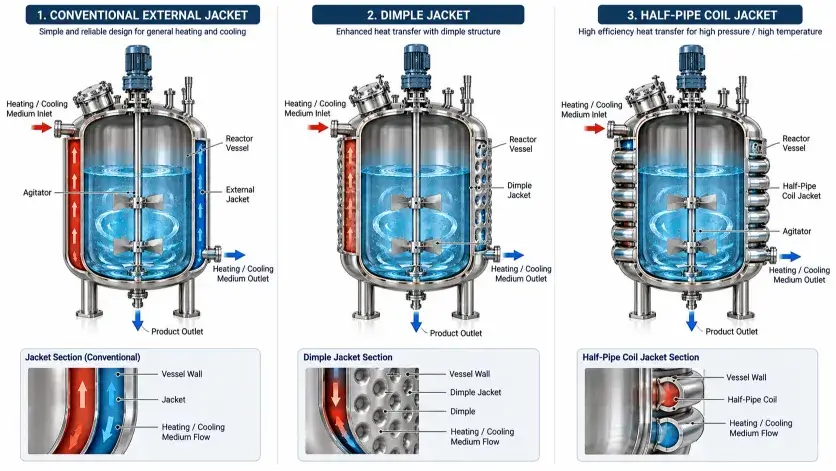
Conventional Jacketed Reactor
A conventional jacket surrounds the process vessel and allows the circulation of heating or cooling media around the vessel wall.
It is suitable for applications requiring controlled indirect heating and cooling.
Dimple Jacket Reactor
A dimple jacket uses formed sections on the vessel exterior to provide a heat-transfer path.
This configuration can be engineered according to the required thermal duty, pressure and vessel geometry.
Half-Pipe Jacketed Reactor
Half-pipe or half-pipe coil configurations provide an external heat-transfer arrangement around the vessel.
They can be selected for applications where the process requires a particular combination of heat-transfer performance and mechanical design.
Heating & Cooling Systems
Temperature control is one of the primary reasons for selecting a jacketed reactor.
Steam Heating
Steam can be circulated through the jacket where the plant’s steam system and required process conditions make it suitable.
Thermic Fluid Heating
Thermic fluid can be used for applications requiring controlled high-temperature heating.
Hot Water Heating
Hot water can be used where moderate-temperature heating is required.
Chilled Water Cooling
Chilled water can be circulated through the jacket to remove heat from the process material.
Brine Cooling
Brine can be used for suitable low-temperature cooling applications.
The heating or cooling medium should be selected according to the required operating temperature, heat-transfer duty and process conditions.
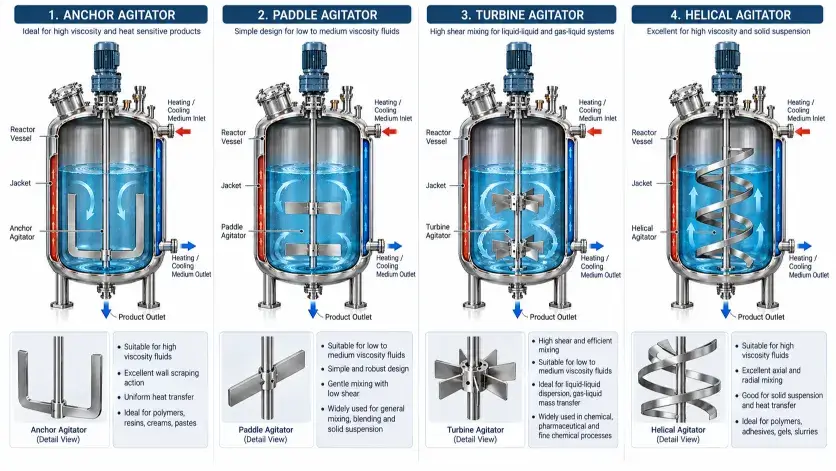
Agitator Options for Jacketed Reactors
The agitator is a critical component of an industrial reactor because mixing affects reaction uniformity and heat transfer.
Liuminex offers multiple agitator configurations that can be selected according to process requirements.
Anchor Agitator
Anchor agitators are commonly considered for higher-viscosity materials and processes where close-to-wall movement and heat-transfer assistance are important.
Paddle Agitator
Paddle configurations can be selected for suitable general mixing applications.
Turbine Agitator
Turbine agitators can be suitable for lower-to-medium viscosity applications and specific mixing requirements.
Helical Agitator
Helical configurations can be considered for viscous products, pastes and thick emulsions.
Magnetic Agitation
Magnetic drive configurations can be considered for applications where minimizing shaft-seal leakage is an important process requirement.
Agitator selection should always be based on actual viscosity, density, batch volume, mixing objective, solids content and process conditions.
Applications of Jacketed Reactors
Liuminex jacketed reaction vessels are designed for a wide range of industrial applications.
Chemical Manufacturing
Jacketed reactors can be used for:
- Chemical synthesis
- Neutralization
- Blending
- Polymerization
- Condensation
- Heat-sensitive processing
Pharmaceutical Industry
Suitable reactor configurations can be used for:
- Pharmaceutical reactions
- Formulation
- Intermediate processing
- Controlled-temperature processes
- Hygienic applications
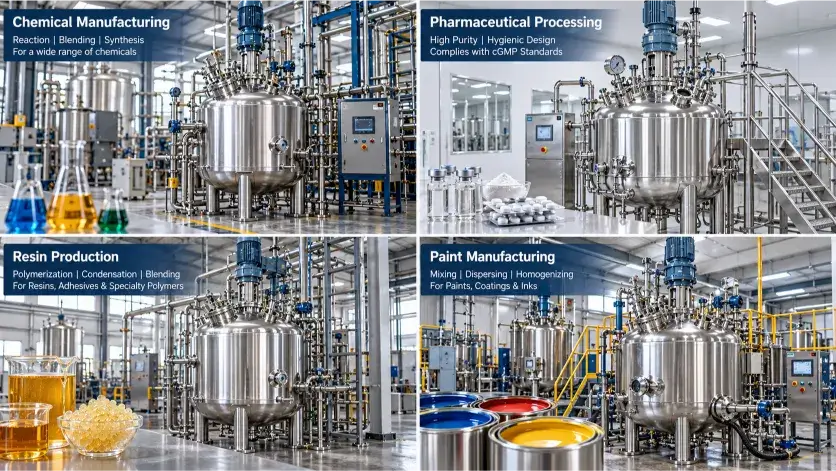
Where pharmaceutical or GMP requirements apply, vessel design, surface finish, cleaning arrangements and documentation should be specified according to the project requirements.
Resin Manufacturing
Resin production can involve controlled heating, cooling and mixing.
Jacketed reactors can be configured for applications involving:
- Alkyd resin
- Epoxy resin
- Polyester resin
- Other resin systems
Paint & Coating Industry
Jacketed reactors can be used in suitable paint and coating processes involving:
- Controlled heating
- Mixing
- Pigment and formulation processing
- Resin-based formulations
- Temperature-sensitive materials
Lubricant Manufacturing
Jacketed reaction vessels can support suitable lubricant and specialty-oil processes requiring controlled heating and mixing.
Grease Manufacturing
Grease and other viscous products can require controlled temperature and effective agitation.
Jacketed reactors can be engineered with suitable agitators and heating/cooling systems according to the material characteristics.
Adhesive Manufacturing
Jacketed vessels can be used for adhesive and emulsion processing where temperature control and controlled mixing are important.
Petrochemical & Specialty Chemical Applications
Customized reaction vessels can also be engineered for suitable petrochemical and specialty chemical processes.
Liuminex’s existing reaction-vessel range identifies chemical, pharmaceutical, resin, paint, lubricant, grease, adhesive, petrochemical and related process applications.
Benefits of a Jacketed Reactor
Controlled Heating and Cooling
The external jacket allows controlled indirect heat transfer without direct contact between the utility fluid and the process material.
Better Process Temperature Management
Controlled heat transfer can help maintain the desired process temperature during heating, reaction and cooling stages.
Improved Batch Consistency
Combining controlled temperature with appropriate agitation can help maintain more consistent process conditions between batches.
Reduced Risk of Direct Heating-Medium Contact
Because the heating or cooling medium remains within the jacket, it does not normally come into direct contact with the product.
Customizable for Different Processes
The vessel, jacket, agitator, material, pressure rating, surface finish and instrumentation can be configured according to the application.
Suitable for Multiple Industries
Jacketed reactors can be designed for diverse chemical and process industries, from specialty chemicals to pharmaceuticals, paints, resins and lubricants.
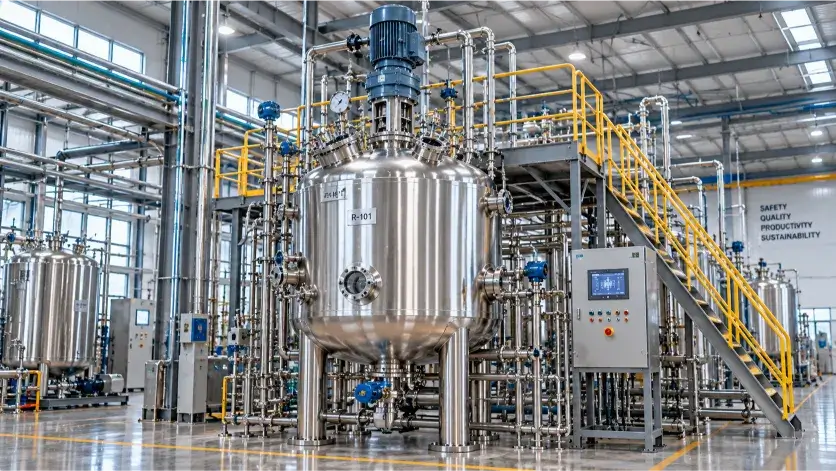
Custom Jacketed Reactor Design
Every industrial process has different requirements.
A reactor for a low-viscosity chemical may require a completely different design from a reactor used for high-viscosity resin or grease.
Liuminex can customize jacketed reactors based on parameters such as:
Vessel Capacity
From smaller production batches to large industrial vessels.
Material of Construction
Selection based on chemical compatibility and operating conditions.
Operating Pressure
The vessel and jacket can be designed according to the required pressure conditions.
Operating Temperature
Design temperature and heating/cooling requirements are established according to the process.
Jacket Configuration
Dimple, conventional or half-pipe configurations can be considered.
Agitator
The agitator is selected according to viscosity, mixing objective and process characteristics.
Surface Finish
Mirror, matt or electro-polished finishes can be provided according to application requirements.
Automation
Instrumentation and automation can be incorporated where required, including VFD-controlled agitation and PLC/SCADA-based systems.
Jacketed Reactor for New Chemical Plants
For a new manufacturing plant, selecting the reactor should be part of the overall process-engineering exercise.
Before finalizing a reactor, manufacturers should establish:
- Required batch capacity
- Working volume
- Product characteristics
- Chemical compatibility
- Viscosity
- Heating requirement
- Cooling requirement
- Operating temperature
- Operating pressure
- Vacuum requirement, if applicable
- Agitation requirements
- Cleaning requirements
- Automation requirements
- Future production expansion
A properly specified reactor can integrate more effectively with utilities, piping, instrumentation and the overall plant layout.
For new plant investors, Liuminex can support customized equipment requirements based on the intended process and production capacity.
Jacketed Reactor Price in India
The price of a jacketed reactor cannot be accurately determined from capacity alone.
Several engineering and manufacturing factors influence the final cost.
Major Cost Factors
1. Capacity
Larger vessels generally require greater material quantities and fabrication effort.
2. Material of Construction
SS 304, SS 316, Mild Steel, Hastelloy and other materials have different material and fabrication costs.
3. Pressure Rating
Higher-pressure designs require appropriate engineering and fabrication.
4. Temperature Requirement
Operating temperature influences material and mechanical design.
5. Jacket Configuration
The selected jacket arrangement affects fabrication and heat-transfer design.
6. Agitator
Agitator type, motor power, gearbox and sealing arrangement affect equipment cost.
7. Surface Finish
Mirror finishing or electro-polishing can increase manufacturing requirements.
8. Instrumentation & Automation
Sensors, VFDs, PLC/SCADA systems and control panels can affect the overall project cost.
9. Customization
A fully customized reactor designed for a specific process is different from a standard vessel.
For an accurate quotation, customers should provide their process requirements, capacity, material, operating temperature, pressure, heating/cooling medium and mixing requirements.
Why Choose Liuminex?
Custom-Designed Equipment
Liuminex develops reactor configurations around the customer’s process requirements instead of relying only on standard equipment configurations.
Engineering Expertise
Reactor performance depends on coordinated decisions involving vessel design, heat transfer, agitation, material selection, pressure and temperature.
Turnkey Solutions
Liuminex can support industrial process-equipment requirements as part of broader plant and project requirements.
PAN India Supply
Liuminex supplies process equipment to customers across India.
Export Capability
Liuminex also supports equipment requirements for export markets, including projects in international regions.
Manufacturing & Fabrication
Liuminex’s existing product information highlights in-house design and fabrication capabilities and customized process-equipment manufacturing.
Installation Support
Installation and commissioning support can be considered according to project requirements.
After-Sales Support
Liuminex develops reactor configurations around the customer’s process requirements instead of relying only on standard equipment configurations.Technical support after equipment supply helps customers maintain reliable long-term equipment operation.
Jacketed Reactor vs Limpet Coil Reactor
Both jacketed and limpet-coil systems can provide indirect heating and cooling, but the appropriate configuration depends on the process.
| Feature | Jacketed Reactor | Limpet Coil Reactor |
|---|---|---|
| Heat-transfer method | External jacket | External coil |
| Heating | Steam / Thermic Fluid / Hot Water | Steam / Thermic Fluid / Hot Oil |
| Cooling | Chilled Water / Brine | Water / Chilled Water / Brine |
| Configuration | Dimple / Conventional / Half-Pipe | Single / Double Coil |
| Customization | Yes | Yes |
| Application | Controlled heating/cooling | Demanding heat-transfer applications |
| Selection | Process dependent | Process dependent |
The final choice should be based on heat-transfer requirements, pressure, temperature, vessel geometry and the overall process design.
Frequently Asked Questions
What is a jacketed reactor?
A jacketed reactor is a reaction vessel with an external jacket through which a heating or cooling medium circulates. The arrangement provides indirect temperature control of the process material.
What is the purpose of a reactor jacket?
The main purpose of the jacket is to provide controlled heating or cooling of the material inside the reactor.
What heating media can be used in a jacketed reactor?
Depending on the process, steam, thermic fluid and hot water can be used for heating.
What cooling media can be used?
Chilled water and brine can be used for suitable cooling applications.
What capacity jacketed reactors does Liuminex manufacture?
The main purpose of the jacket is to provide controlled heating or cooling of the material within the reactor.
Which materials are available?
Depending on process requirements, Liuminex lists SS 304, SS 316, Mild Steel, Hastelloy and Alloy 20 options.
Can a jacketed reactor be customized?
Yes. Capacity, material, jacket configuration, agitator, pressure, temperature, surface finish, mounting and instrumentation can be customized according to the process.
Can a jacketed reactor be used for pharmaceutical applications?
Yes, suitable configurations can be designed for pharmaceutical processes. GMP-related requirements, surface finish, cleaning and documentation should be established according to the application.
How much does a jacketed reactor cost in India?
The cost depends on capacity, material, pressure, temperature, jacket type, agitator, automation, surface finish and customization. A process-specific quotation is required for accurate pricing.
Does Liuminex supply jacketed reactors across India?
Yes. Liuminex supplies process equipment across India and also supports export requirements.
Get a Custom Jacketed Reactor Quote
Tell Us Your Process Requirements
Whether you are setting up a new chemical plant, expanding production capacity or replacing an existing reactor, Liuminex can help develop a jacketed reactor configuration around your process requirements.
Share details such as:
- Required capacity
- Product / chemical
- Material of construction
- Operating temperature
- Operating pressure
- Heating medium
- Cooling medium
- Agitator requirement
- Batch time
- Application
- Automation requirement
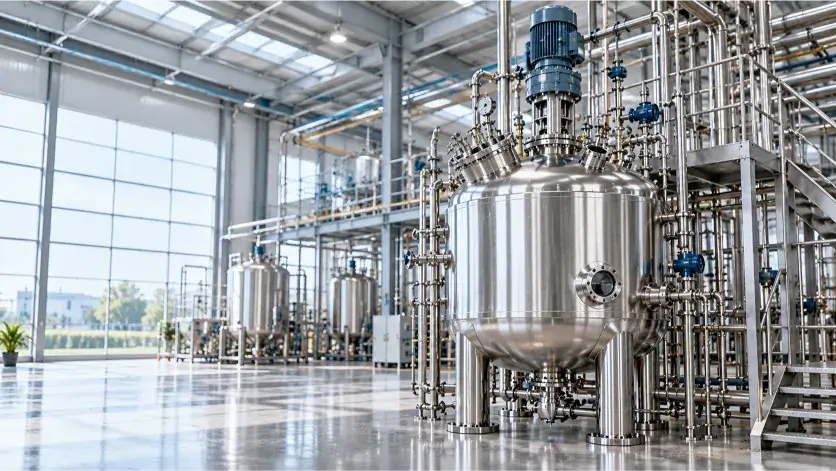
Our engineering team can evaluate the requirements and propose a suitable reactor configuration.
Jacketed Reactors | Reaction Vessels | Process Equipment
Get in touch with Liuminex for your customized jacketed reactor requirement.
Blogs


Home About Us Products Stainless Steel Reaction Vessel Heat Exchangers and Condensers Industrial Storage Tanks Ribbon Blender Plough Shear Mixer Vacuum & Solvent Receivers Rotary Vacuum Paddle Dryer (RVPD) Rotary
Home About Us Products Stainless Steel Reaction Vessel Heat Exchangers and Condensers Industrial Storage Tanks Ribbon Blender Plough Shear Mixer Vacuum & Solvent Receivers Rotary Vacuum Paddle Dryer (RVPD) Rotary
Home About Us Products Stainless Steel Reaction Vessel Heat Exchangers and Condensers Industrial Storage Tanks Ribbon Blender Plough Shear Mixer Vacuum & Solvent Receivers Rotary Vacuum Paddle Dryer (RVPD) Rotary
Home About Us Products Stainless Steel Reaction Vessel Heat Exchangers & Condensers Industrial Storage Tanks Ribbon Blender Plough Shear Mixer Vacuum & Solvent Receivers Rotary Vacuum Paddle Dryer (RVPD) Rotary
Home About Us Products Stainless Steel Reaction Vessel Heat Exchangers & Condensers Industrial Storage Tanks Ribbon Blender Plough Shear Mixer Vacuum & Solvent Receivers Rotary Vacuum Paddle Dryer (RVPD) Rotary
Home About Us Products Stainless Steel Reaction Vessel Heat Exchangers & Condensers Industrial Storage Tanks Ribbon Blender Plough Shear Mixer Vacuum & Solvent Receivers Rotary Vacuum Paddle Dryer (RVPD) Rotary
Home About Us Products Stainless Steel Reaction Vessel Heat Exchangers & Condensers Industrial Storage Tanks Ribbon Blender Plough Shear Mixer Vacuum & Solvent Receivers Rotary Vacuum Paddle Dryer (RVPD) Rotary
Home About Us Products Stainless Steel Reaction Vessel Heat Exchangers & Condensers Industrial Storage Tanks Ribbon Blender Plough Shear Mixer Vacuum & Solvent Receivers Rotary Vacuum Paddle Dryer (RVPD) Rotary
Home About Us Products Stainless Steel Reaction Vessel Heat Exchangers & Condensers Industrial Storage Tanks Ribbon Blender Plough Shear Mixer Vacuum & Solvent Receivers Rotary Vacuum Paddle Dryer (RVPD) Rotary