
Grease Manufacturing Plant Cost
Grease Manufacturing Plant Cost is one of the most important considerations for entrepreneurs planning to enter the lubricant manufacturing industry. The global demand for industrial lubricants and grease products is increasing rapidly because of continuous growth in the automotive, construction, mining, marine, agriculture, and manufacturing industries. Grease plays a critical role in reducing friction, preventing corrosion, improving machinery life, and ensuring smooth operation of industrial equipment. Because of this growing demand, many entrepreneurs and industrial investors are now looking to establish a grease manufacturing plant.
One of the most important questions before starting this business is: What is the grease manufacturing plant cost? The answer depends on several factors such as plant capacity, automation level, raw material quality, machinery type, land requirement, utility setup, storage system, packaging line, and compliance standards.
A grease manufacturing unit can be started on a small scale, medium scale, or large industrial scale depending on the target market and production goals. While a small-scale grease plant may require a moderate investment, a fully automatic industrial grease manufacturing facility requires a significantly larger capital investment.
In this detailed guide, we will explain everything about grease manufacturing plant cost, including:
- Grease manufacturing process
- Types of grease produced
- Raw materials required
- Machinery and equipment cost
- Land and infrastructure investment
- Utility and manpower requirements
- Packaging and storage setup
- Profit margins and ROI
- Factors affecting project cost
- Tips for reducing setup cost
- Why choosing the right plant manufacturer matters
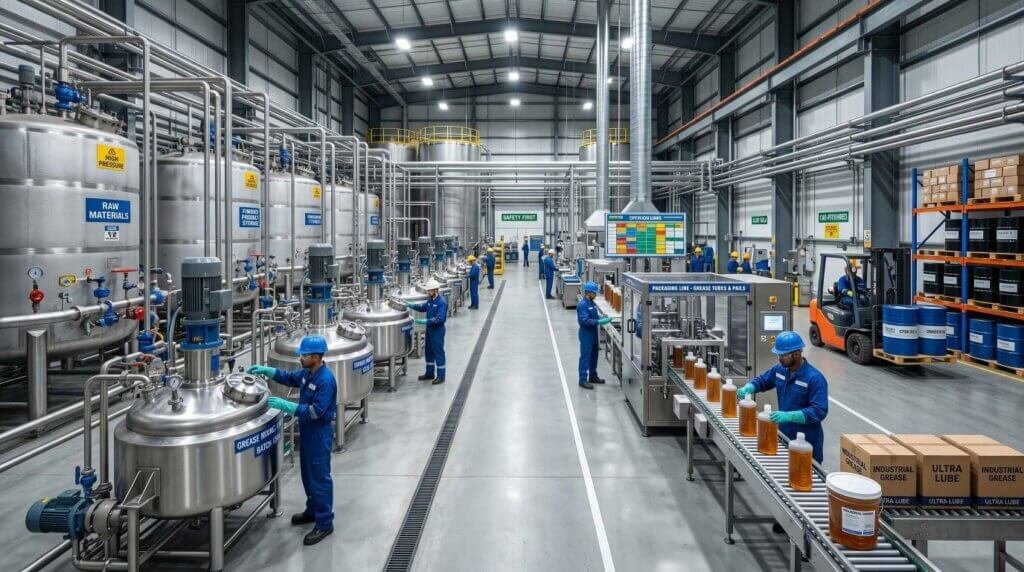
If you are planning to invest in a grease manufacturing business, this Article will help you understand the complete project structure and budget planning.
What is Grease?
Grease is a semi-solid lubricant made by combining base oil, thickening agents, and additives. Unlike liquid lubricants, grease remains in place and provides long-lasting lubrication under high pressure, high temperature, and harsh operating conditions.
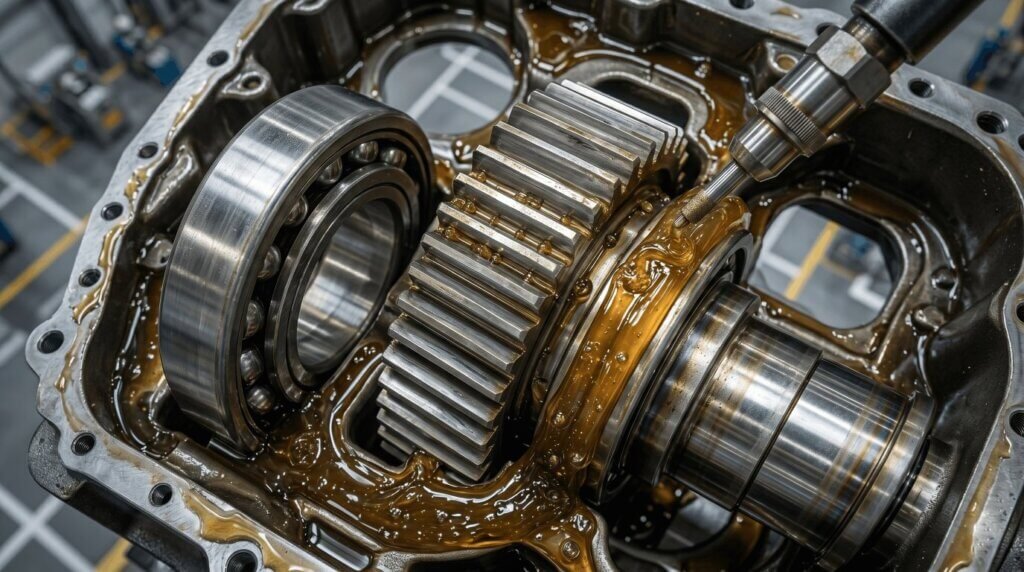
Grease is commonly used in:
- Bearings
- Gears
- Automotive components
- Heavy machinery
- Industrial equipment
- Construction machines
- Agricultural equipment
- Marine systems
- Mining equipment
The performance and quality of grease depend on its formulation and manufacturing process.
Types of Grease Manufactured in Industrial Plants
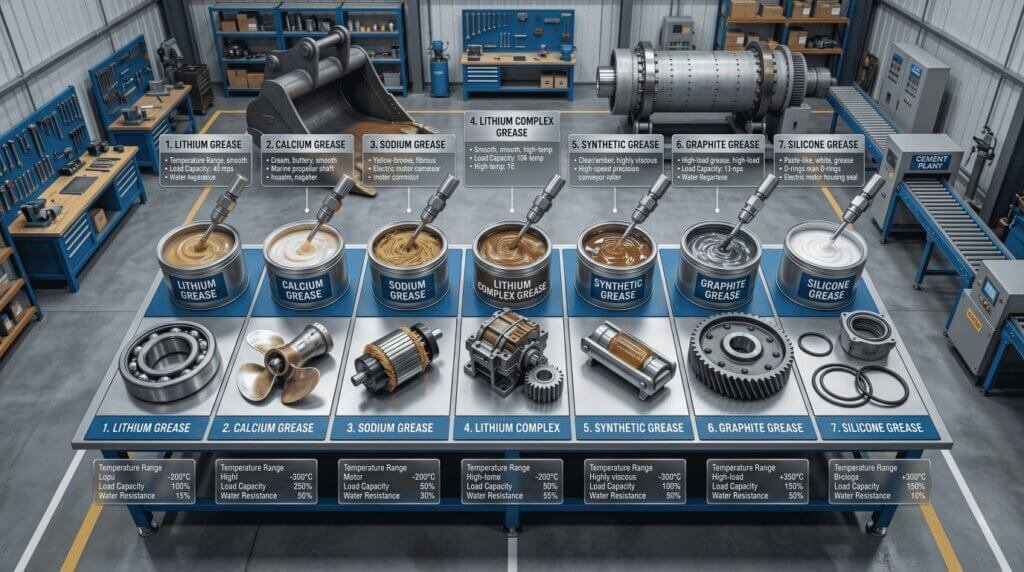
Before calculating grease manufacturing plant cost, it is important to understand the types of grease products produced in a typical facility.
Lithium Grease
Lithium grease is the most widely used industrial grease because of its excellent water resistance and high-temperature stability.
Applications:
- Automotive bearings
- Industrial machinery
- Electric motors
- Wheel hubs
Calcium Grease
Calcium grease offers excellent water resistance and is suitable for wet environments.
Applications:
- Marine equipment
- Water pumps
- Agricultural machinery
Sodium Grease
Sodium grease performs well at higher temperatures but has lower water resistance.
Applications:
- Industrial bearings
- Conveyor systems
Complex Grease
Complex grease is used in high-performance industrial applications requiring high thermal stability.
Applications:
- Steel plants
- Cement industries
- Mining operations
Specialty Grease
Specialty grease products include:
- Food-grade grease
- High-temperature grease
- EP grease
- Synthetic grease
- Silicone grease
- Graphite grease
Each grease type requires specific formulations, processing systems, and quality control methods.
Grease Manufacturing Process
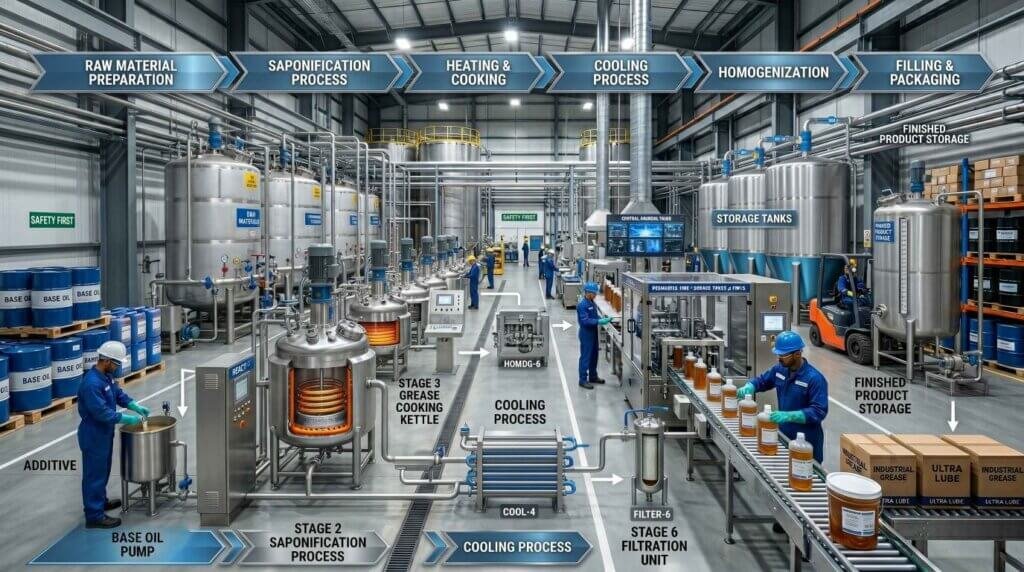
Understanding the manufacturing process helps estimate the actual plant setup and machinery requirements.
Step 1 – Raw Material Preparation
The process starts with preparing base oil, thickener, and additives.
Main raw materials include:
- Base oil
- Fatty acids
- Lithium hydroxide
- Calcium hydroxide
- Additives
- Performance enhancers
Step 2 – Saponification Process
This is the most critical stage in grease manufacturing.
In this process:
- Base oil and thickener react chemically
- Controlled heating is required
- Agitation and temperature control are essential
The reaction creates soap-based thickener structures.
Step 3 – Cooking and Heating
The material is heated at controlled temperatures inside the grease kettle.
This stage determines:
- Grease texture
- Stability
- Consistency
- Performance quality
Step 4 – Cooling Process
The grease mixture is cooled gradually using cooling systems.
Proper cooling is important for achieving:
- Smooth texture
- Stable structure
- Desired penetration value
Step 5 – Homogenization
The grease is processed through a homogenizer or colloid mill to improve consistency and smoothness.
Step 6 – Filtration
Filtration removes impurities and unwanted particles.
Step 7 – Storage
Finished grease is stored in storage tanks before packaging.
Step 8 – Filling and Packaging
Grease is packed into:
- Buckets
- Barrels
- Drums
- Tubes
- Containers
- Small retail packs
The packaging system can be semi-automatic or fully automatic.
Major Components of a Grease Manufacturing Plant
A complete grease manufacturing facility includes multiple systems.
Grease Reactor or Kettle
The reactor is the heart of the plant.
Functions:
- Heating
- Mixing
- Chemical reaction
- Cooking process
Agitator System
Ensures proper mixing of ingredients.
Heating System
Can include:
- Thermic fluid heaters
- Electric heating
- Steam heating systems
Cooling System
Used for temperature reduction and process stabilization.
Homogenizer
Improves grease texture and consistency.
Transfer Pumps
Used for material handling and transfer.
Storage Tanks
Required for:
- Base oil
- Finished grease
- Additives
Filling and Packaging Machines
Used for final product packaging.
Control Panel and Automation System
Modern plants use PLC automation for:
- Temperature control
- Batch monitoring
- Process automation
Grease Manufacturing Plant Cost Breakdown
Now let us understand the detailed grease manufacturing plant cost structure.
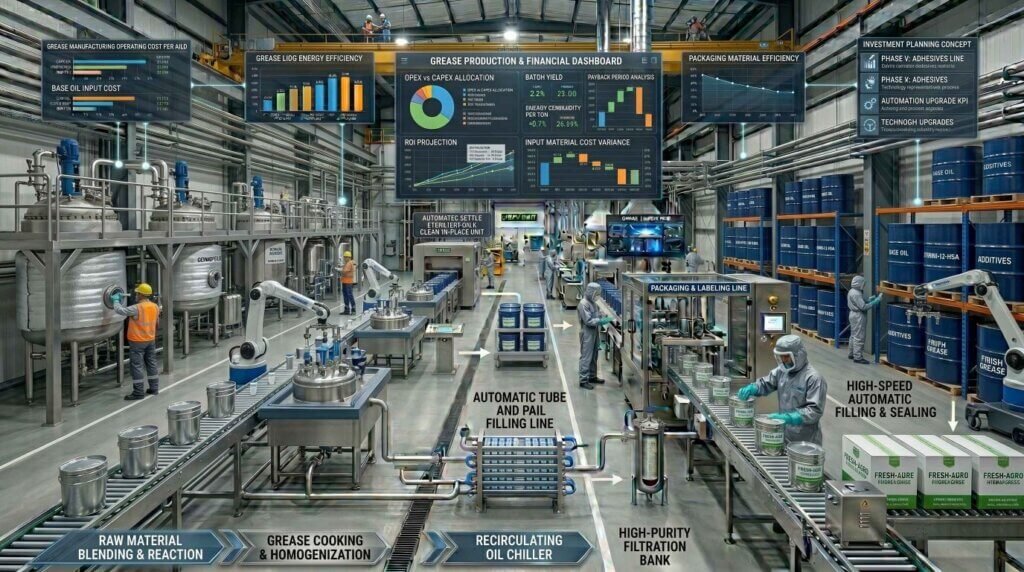
The investment depends mainly on:
- Production capacity
- Automation level
- Product range
- Utility setup
- Packaging requirements
- Land and building size
Small Scale Grease Manufacturing Plant Cost
A small-scale grease plant is suitable for:
- Local lubricant businesses
- Regional distributors
- Startup manufacturers
- Private label production
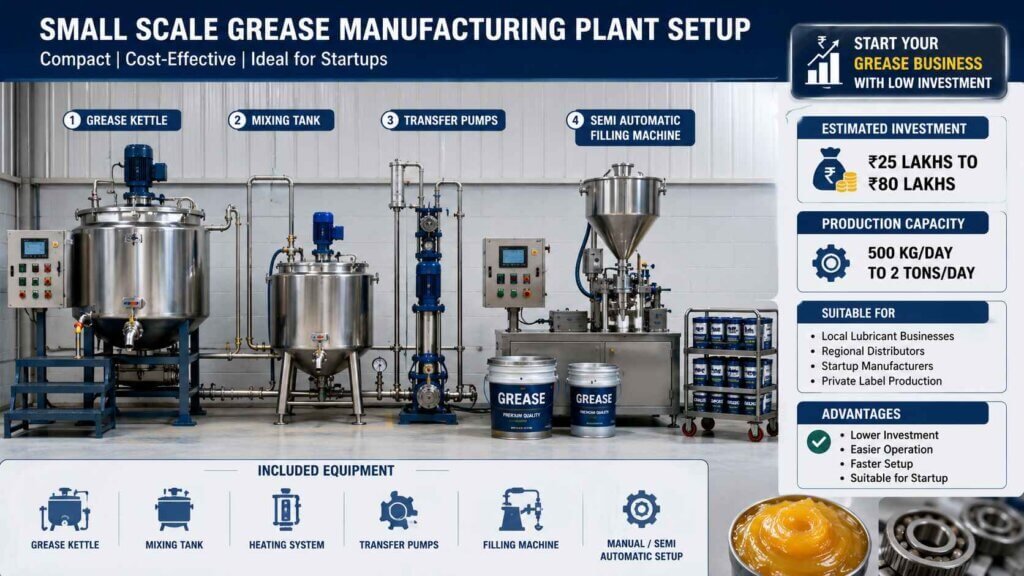
Estimated Investment
Approximate investment:
- ₹25 Lakhs to ₹80 Lakhs
Production Capacity
Typical production:
- 500 kg/day to 2 tons/day
Included Equipment
- Small grease kettle
- Mixing tank
- Basic heating system
- Transfer pumps
- Small filling machine
- Manual or semi-automatic setup
Advantages
- Lower investment
- Easier operation
- Faster setup
- Suitable for startup
Medium Scale Grease Manufacturing Plant Cost
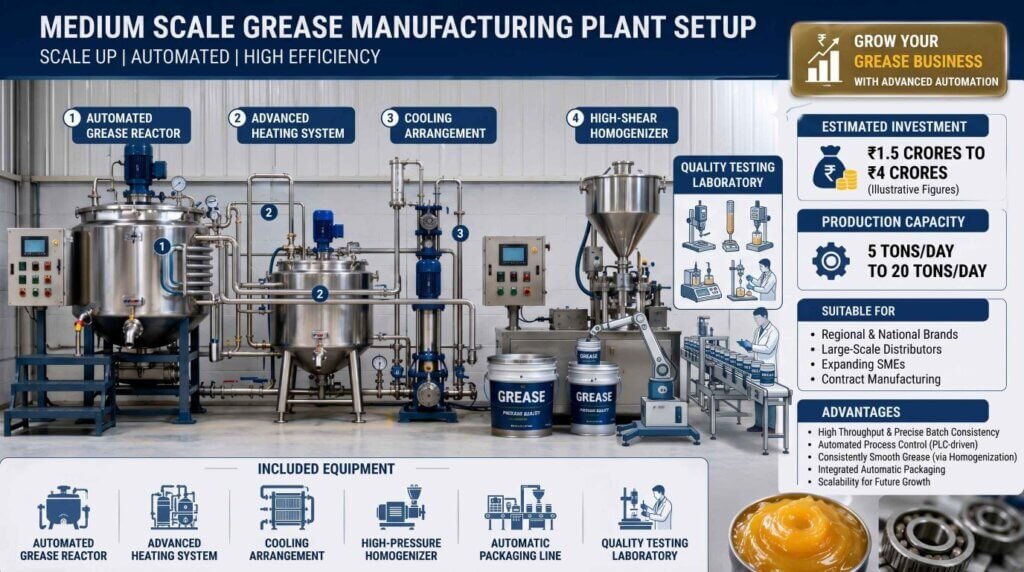
Medium-scale plants are ideal for companies targeting multiple industrial customers.
Estimated Investment
Approximate investment:
- ₹80 Lakhs to ₹3 Crores
Production Capacity
Typical capacity:
- 3 tons/day to 15 tons/day
Included Systems
- Automated grease reactor
- Advanced heating system
- Cooling arrangement
- Homogenizer
- Semi-automatic or automatic packaging line
- Quality testing laboratory
Benefits
- Higher production efficiency
- Better product consistency
- Increased profit margins
- Wider product portfolio
Large Scale Grease Manufacturing Plant Cost
Large industrial grease plants are designed for mass production and nationwide supply.
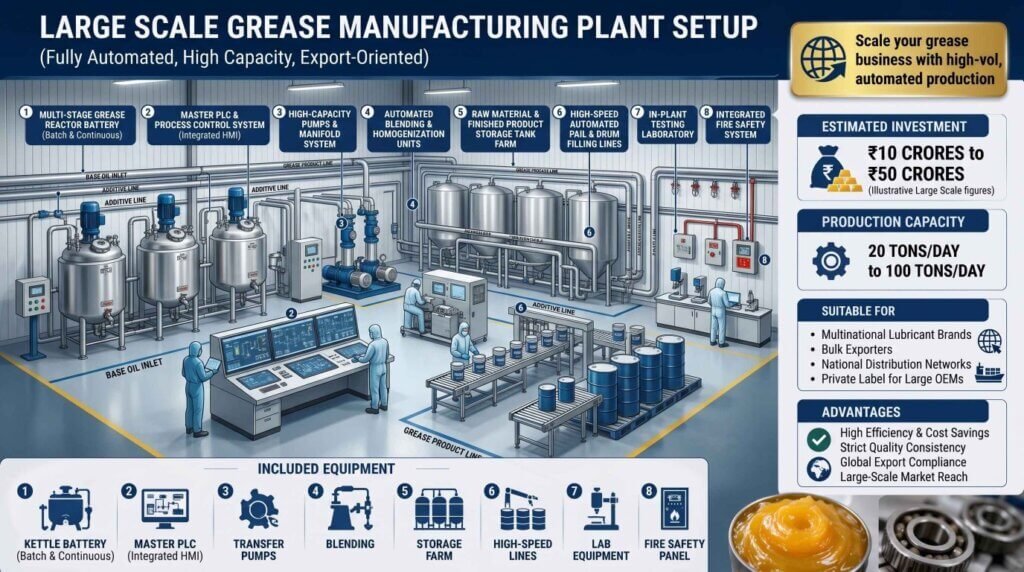
Estimated Investment
Approximate investment:
- ₹3 Crores to ₹25 Crores or more
Production Capacity
Approximate investment:
- ₹3 Crores to ₹25 Crores or more20 tons/day to 100+ tons/day
Included Infrastructure
- Multiple grease reactors
- Fully automated production line
- PLC control systems
- Bulk storage tanks
- Drum filling systems
- High-speed packaging lines
- Laboratory setup
- Fire safety systems
- Pollution control systems
Advantages
- Large-scale commercial production
- Export potential
- High production efficiency
- Lower per-unit manufacturing cost
Machinery Cost for Grease Manufacturing Plant
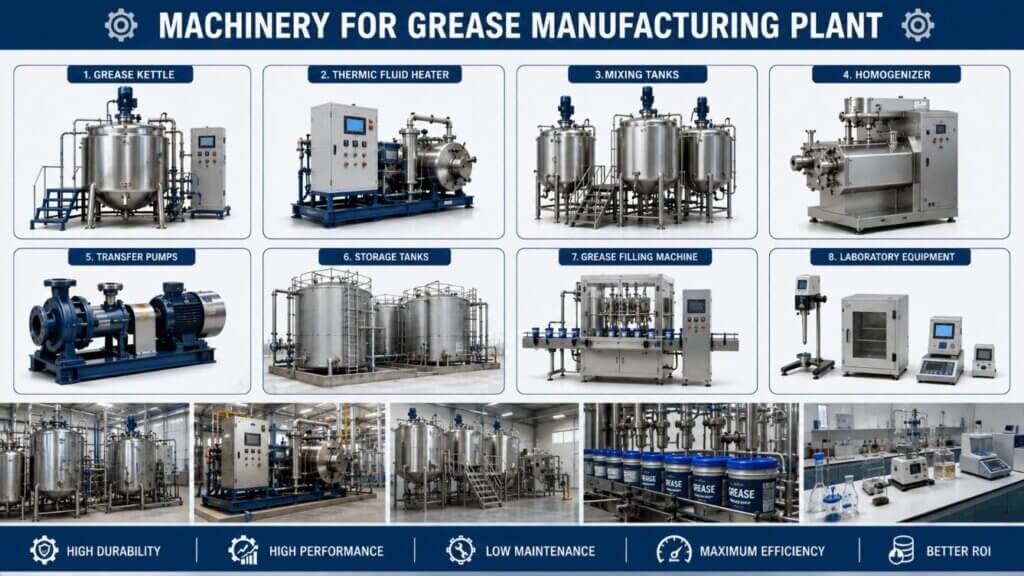
Machinery cost forms a major portion of the total project investment.
Main Machinery Required
Grease Kettle
Estimated cost:
- ₹5 Lakhs to ₹80 Lakhs
Depends on:
- Capacity
- Material grade
- Heating type
- Pressure design
Thermic Fluid Heater
Estimated cost:
- ₹3 Lakhs to ₹25 Lakhs
Mixing Tanks
Estimated cost:
- ₹2 Lakhs to ₹15 Lakhs
Homogenizer
Estimated cost:
- ₹2 Lakhs to ₹20 Lakhs
Transfer Pumps
Estimated cost:
- ₹50,000 to ₹5 Lakhs
Storage Tanks
Estimated cost:
- ₹1 Lakh to ₹25 Lakhs
Grease Filling Machine
Estimated cost:
- ₹2 Lakhs to ₹30 Lakhs
Laboratory Equipment
Estimated cost:
- ₹3 Lakhs to ₹20 Lakhs
Land and Building Cost
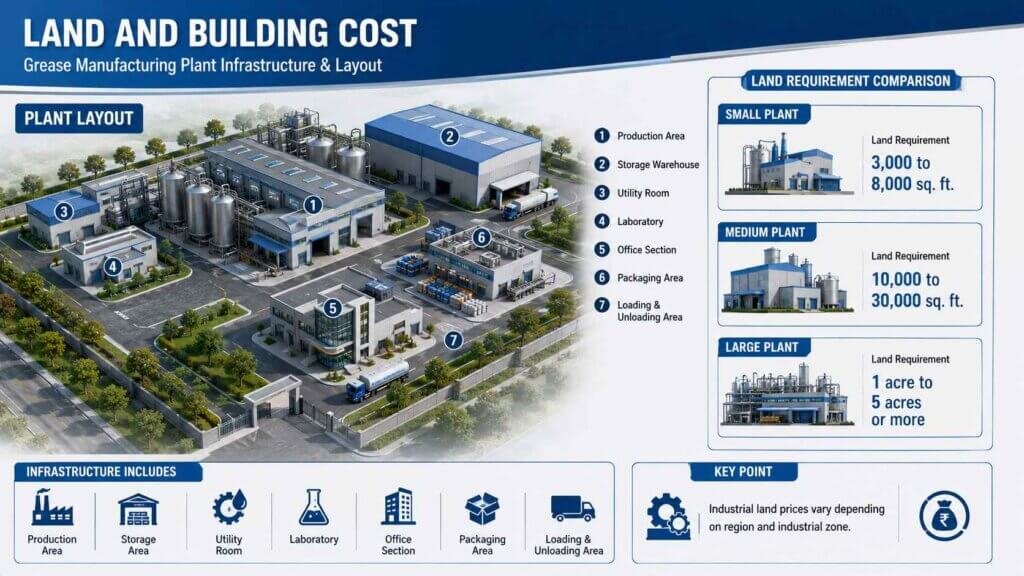
Land cost depends on location and plant size.
Small Plant
Land requirement:
- 3,000 to 8,000 sq. ft.
Medium Plant
Land requirement:
- 10,000 to 30,000 sq. ft.
Large Plant
Land requirement:
- 1 acre to 5 acres or more
Infrastructure Includes
- Production area
- Storage area
- Utility room
- Laboratory
- Office section
- Packaging area
- Loading and unloading area
Industrial land prices vary depending on region and industrial zone.
Utility Requirements and Cost
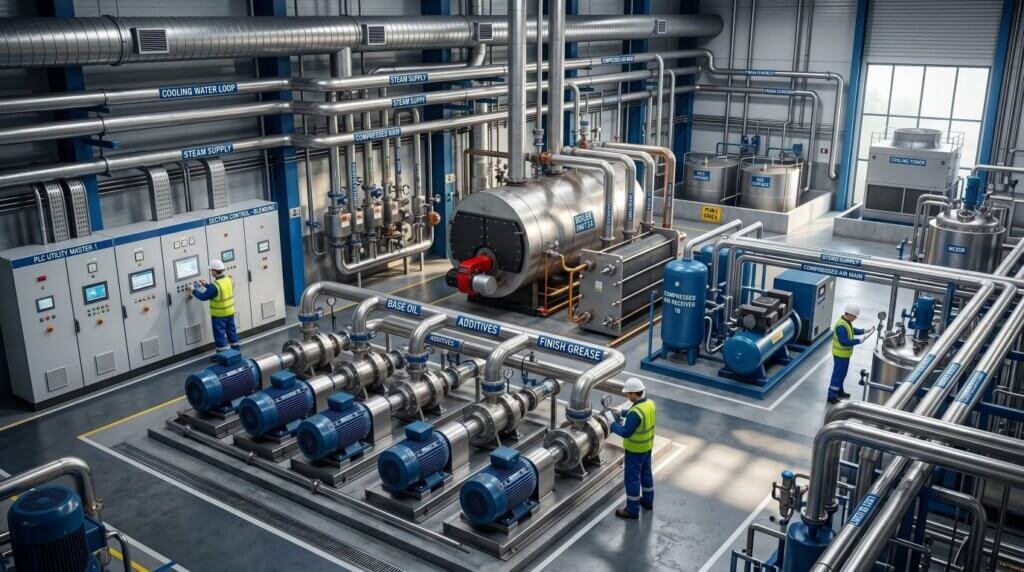
Utilities are essential for continuous grease manufacturing operations.
Electricity
Required for:
- Motors
- Pumps
- Heating systems
- Filling machines
- Lighting
Water Supply
Needed for:
- Cooling systems
- Cleaning
- Utility operations
Fuel Requirement
Fuel may include:
- Diesel
- Gas
- Furnace oil
- Electricity
Compressed Air System
Used in automated plants.
Utility Cost Estimate
Monthly utility cost may range from:
- ₹50,000 to ₹15 Lakhs depending on plant scale
Raw Material Cost in Grease Manufacturing
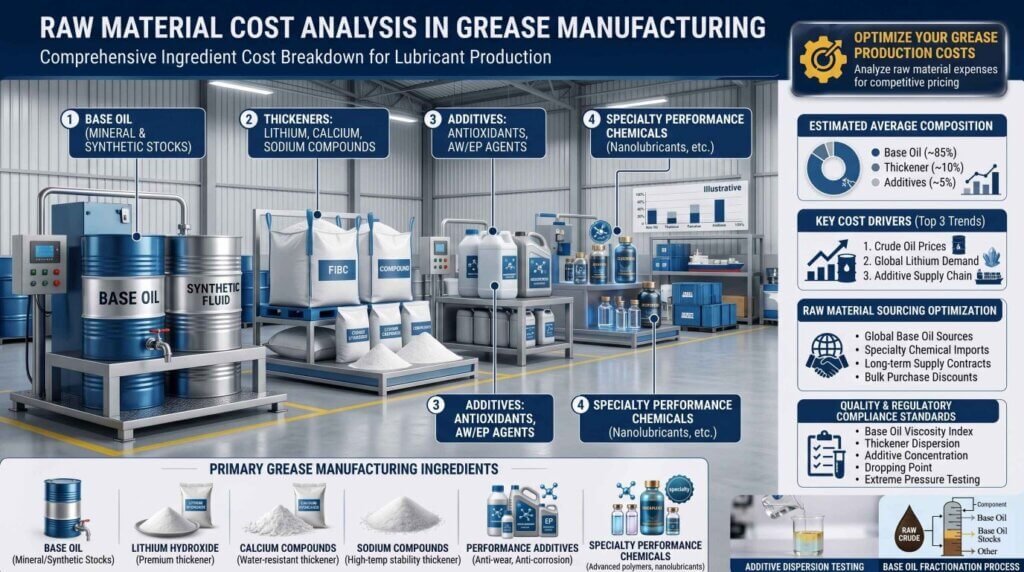
Raw material cost is one of the biggest operational expenses.
Main Raw Materials
Base Oil
Forms the primary component of grease.
Thickener
Examples:
- Lithium hydroxide
- Calcium compounds
- Sodium compounds
Additives
Used to improve:
- Oxidation resistance
- Pressure resistance
- Anti-rust properties
- Temperature performance
Performance Chemicals
Used for specialty grease formulations.
Frequently Asked Questions (FAQs)
1. What is the cost of a grease manufacturing plant in India?
The cost of a grease manufacturing plant in India depends on plant capacity, automation level, and machinery configuration. A small-scale plant may cost around ₹25 Lakhs, while a fully automatic large-scale grease manufacturing plant can cost ₹25 Crores or more.
2. What is the future scope of the grease manufacturing business?
The grease manufacturing industry has strong future growth because of increasing industrialization, automotive production, infrastructure development, and rising demand for industrial lubricants globally.
3. How long does it take to set up a grease manufacturing plant?
The setup time depends on project size and customization. On average:
- Small plants: 2–4 months
- Medium plants: 4–8 months
- Large industrial plants: 8–18 months
4. What is the production capacity of a grease manufacturing plant?
Production capacity depends on plant size:
- Small plant: 500 kg/day to 2 tons/day
- Medium plant: 3–15 tons/day
- Large plant: 20–100+ tons/day
5. Why is quality control important in grease manufacturing?
Quality control ensures:
- Product consistency
- Better lubrication performance
- Customer satisfaction
- Compliance with industrial standards
- Longer machinery life
Testing helps maintain reliable grease quality.